ᛁᚷᛞᚱᚨᛊᛁᛚ
yggdrasill
Home > Table of contents > Norse mythology > norse cosmology > yggdrasil
Yggdrasil
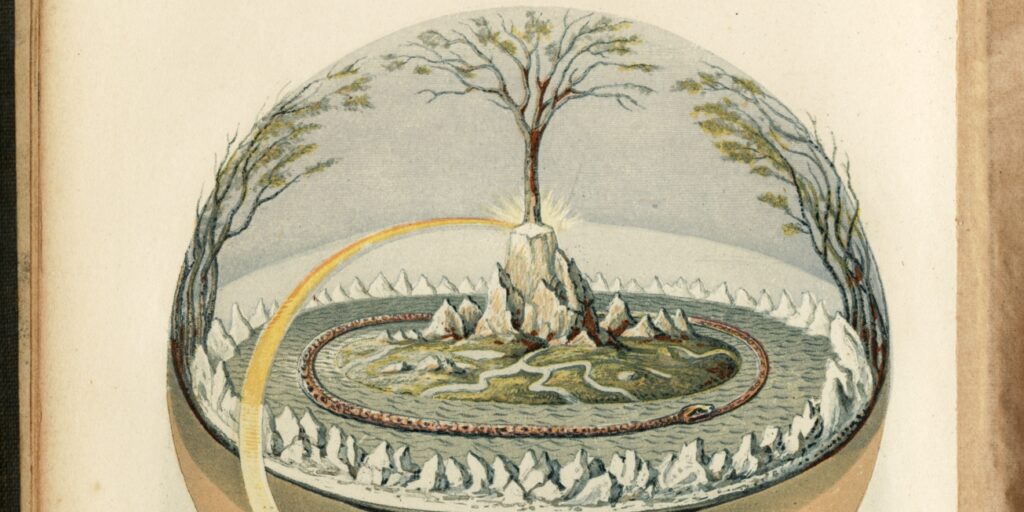
Yggdrasil is the immense and sacred world tree at the heart of Norse cosmology. All existence revolves around it, including the Nine Worlds. Described in both the Poetic Edda and the Prose Edda, Yggdrasil is a vast ash tree that binds the cosmos together and is considered the holiest place of the gods.
The gods gather at Yggdrasil each day to hold their councils and decide the fate of the worlds. Its branches stretch into the heavens, while its three great roots reach deep into different realms: one to Urðarbrunnr, the well of fate in the heavens; one to Mímisbrunnr, the well of wisdom; and one to Hvergelmir, the primal spring in the depths of Niflheim.
Many beings dwell on and around the tree. At its roots gnaws the dragon Níðhöggr, while the squirrel Ratatoskr carries messages between the depths and the heights. An unnamed eagle sits atop the tree with the hawk Veðrfölnir between its eyes, and four stags, Dáinn, Dvalinn, Duneyrr, and Duraþrór feed on its branches. Despite constant decay and attack, Yggdrasil endures, sustained by the Norns, who water it daily to preserve its life.
Yggdrasil is also deeply tied to Odin. According to Hávamál, Odin sacrificed himself by hanging from the tree for nine nights to gain knowledge of the runes. This act links Yggdrasil to death, wisdom, sacrifice, and rebirth. At Ragnarök, the tree will tremble as the old world ends, yet it will survive, sheltering Líf and Lífþrasir, from whom humanity will be reborn.
More than a tree, Yggdrasil is the living structure of the Norse universe. An eternal symbol of life, decay, fate, and renewal.
<<< previous page
norse cosmology
next page >>>