ᚾᛁᚢ ᚺᛖᛁᛗᚨᚱ
níu heimar
Home > Table of contents > Norse mythology > norse cosmology > the nine worlds
The nine worlds
In Norse mythology, the cosmos is composed of multiple interconnected worlds, each inhabited by distinct beings and governed by specific rules and powers. Central to this cosmology is Yggdrasil, the World Tree, whose roots and branches connect these realms, forming the framework of existence.
Ásgarðr
Asgard (Old Norse: Ásgarðr, “Enclosure of the Æsir”) is the fortified home of the Æsir gods and appears in numerous mythological texts, including the Poetic and Prose Eddas. It contains important sites such as Valhalla, Iðavöllr, and Hlidskjálf, the high seat of Odin from which he sees all worlds. Asgard is often described in golden imagery, emphasizing its divine and majestic nature. In the Prose Edda, Snorri Sturluson presents an euhemerized account portraying Asgard as Troy, from which the Æsir migrated north, bringing their advanced knowledge and becoming revered as gods. In traditional myth, however, Asgard is not fixed geographically; it may exist over the rainbow bridge Bifröst, in the center of the world, or even above the sea. Its halls, such as Glaðsheimr for the male gods and Vingólf for the goddesses, are described as the finest buildings, made of gold and hosting the gods’ councils. Asgard also features in stories of the construction of its fortifications, including the tale of the unnamed jötunn builder and his stallion Svaðilfari, and the interventions of Loki and Thor to protect the gods.
Vanaheimr
Vanaheimr is the realm of the Vanir, a group of gods associated with fertility, wisdom, and prophecy. It is primarily attested as the birthplace of the god Njörðr, who later becomes a hostage among the Æsir after the Æsir–Vanir War. Its position among the Nine Worlds is uncertain, but it may have connections to the underworld or mystical aspects of nature. Some sources place it near the Don River, referred to as “Vana Fork,” in euhemerized accounts. Vanaheimr illustrates the complex relationships between divine tribes in Norse myth, especially through exchange and diplomacy after conflict.
Álfheimr / Ljósálfheimr
Álfheimr, or Ljósálfheimr, is the home of the Light Elves, beings described as fairer than the sun. In contrast, the Dark Elves (Dökkálfar) dwell underground and appear blacker than pitch, highlighting the duality of light and dark within the mythological cosmos. Álfheimr is a divine gift to the god Frey and is located in one of the higher heavens, separate from the human world and other divine abodes.
Miðgarðr
Midgard (Old Norse: Miðgarðr, “middle enclosure”) is the realm of humans. It is created from the body of Ymir, the primordial being, whose flesh became the land, blood the oceans, bones the mountains, teeth the cliffs, and skull the dome of the sky. Midgard is enclosed and protected from the jötnar by divine fortifications and is considered the center of human existence. It is destined to be destroyed during Ragnarök when Jörmungandr, the Midgard Serpent, rises, poisoning the land and sea, after which the world is renewed. The term “Midgard” is cognate with Old English Middangeard, the basis for Tolkien’s “Middle-earth.”
Jötunheimr
Jötunheimr is the land of the jötnar (giants), usually located to the north or east. It is often depicted as a remote and perilous region, separated from the gods and humans by barriers such as forests, mountains, or seas. Jötunheimar are not necessarily fixed geographically but are instead reached through special paths that defy normal navigation, emphasizing the otherworldly nature of its inhabitants. Myths feature journeys to Jötunheimar, including Freyr’s courtship of Gerðr, Thor’s recovery of Mjölnir from Þrymr, and Loki’s interactions with the jötunn Þjazi. The realm reflects the chaotic, untamed forces that contrast with the order of Asgard and Midgard.
Muspelheimr
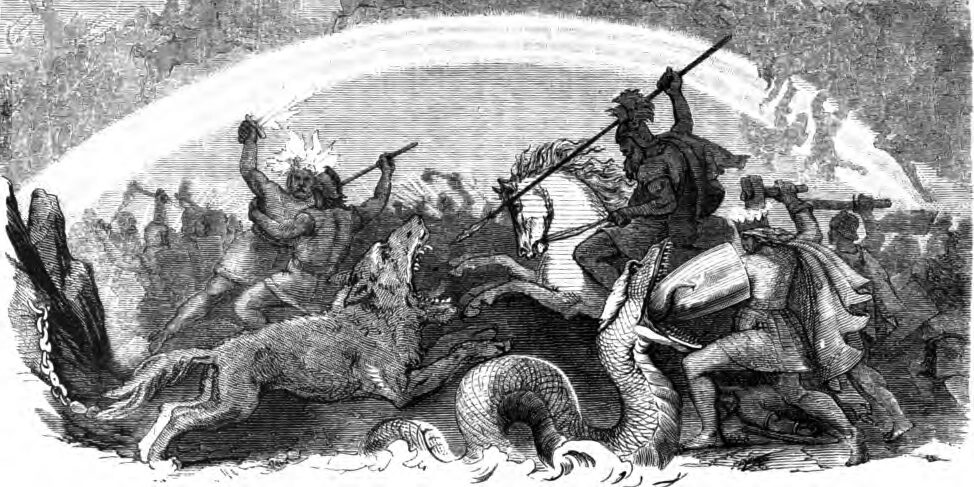
Muspelheim is the fiery realm of the fire giants, ruled by Surtr. Alongside Niflheim, the icy primordial realm, Muspelheim plays a role in creation. When the heat of Muspelheim met the ice of Niflheim, life emerged, including Ymir, the first being. During Ragnarök, the sons of Muspell will march across Bifröst, breaking it, and set the world ablaze, signaling the destruction and subsequent renewal of existence.
Svartálfheimr / Niðavellir
Svartálfheimr, also called Niðavellir, is the subterranean home of the dwarfs, or “black elves” (svartálfar). It is a place of craftsmanship, where legendary smiths like the Sons of Ivaldi produce magical items for the gods, such as the fetter Gleipnir and Sif’s replacement hair. Svartálfheimr underscores the importance of skilled labor and magical knowledge in Norse cosmology, bridging the divine and material realms.
Niflheimr
Niflheim, the world of mist and ice, is one of the two primordial realms alongside Muspelheim. It contains Hvergelmir, the source of the Élivágar rivers, and later becomes associated with the afterlife, ruled by the goddess Hel. Niflheim is sometimes equated with Niflhel, the lower part of Hel, and is located beneath one of Yggdrasil’s roots. Life, death, and the cyclical nature of the cosmos are closely tied to Niflheim, as the melting of its ice by Muspelheim sparks creation, while its cold serves as the realm of the dead who die of sickness or old age.
Hel
Hel, the being and her realm, presides over the dead who are not honored with heroic deaths. Her hall, Éljúðnir, is described as massive, with high walls, gates, and servants. Access to Hel involves traversing valleys, crossing the river Gjöll, and passing the Gjöll bridge, which is guarded by Móðguð. Hel’s domain is central in myths such as the death of Baldr, where Hermóðr journeys to retrieve him. While Snorri Sturluson’s Prose Edda offers the most detailed description, some scholars argue it may reflect Christian influence or literary invention.
Together, these realms constitute the Nine Worlds of Norse cosmology. They include Asgard, Vanaheimr, Álfheimr, Midgard, Jötunheimr, Muspelheim, Svartálfheimr/Niðavellir, Niflheim, and Hel/Niflhel. Each world has its own inhabitants, characteristics, and role in the myths, all connected through Yggdrasil and traversed by gods, giants, elves, dwarfs, and humans. This complex cosmology weaves creation, divine politics, human existence, and the cycle of destruction and renewal into a rich mythological tapestry.
<<< previous page
yggdrasil
next page >>>